class: center, middle # EE-361 ELECTROMECHANICAL ENERGY CONVERSION ## Ozan Keysan [keysan.me](http://keysan.me) Office: C-113 <span class="meta">•</span> Tel: 210 7586 --- <!-- # Review ## Magnetic circuits are analogous to electric circuits: - ### EMF __> MMF (NI) - ### Current __> Flux (\\(\Phi\\)) ### Current Density __> Flux Density (B) - ### Resistance __> Reluctance # Review ## Ampere's Law ## $$\oint_C {\vec{H}.d\vec{\ell}}= \sum I_n$$ #Review ## Flux Linkage ### \\(\lambda = N_{turns} \Phi \\) (turn. Weber) ## Faraday's Law ## \\(V_{coil} = -N\frac{d \Phi}{dt} = -\frac{d \lambda}{dt}\\) --> # What is an Inductor? -- 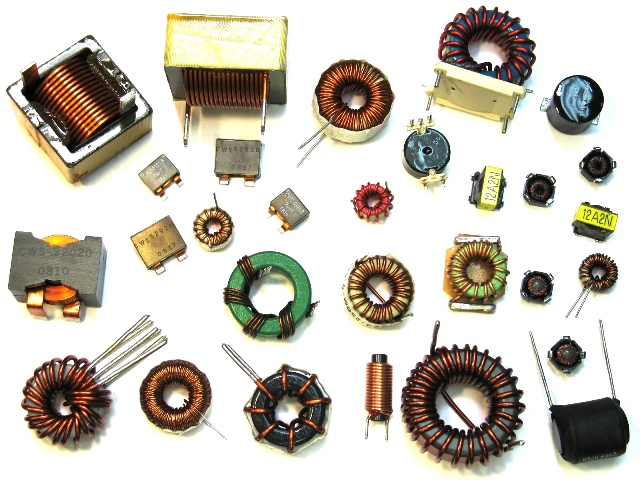 --- # Relation between Magnetic and Electric Circuits -- ## \\( V\_L = N \dfrac{d \Phi}{dt}= N \dfrac{d \Phi}{di} \dfrac{di}{dt}\\) -- ## \\( V\_L =L \dfrac{di}{dt}\\) --- # Inductance ## Inductance is the flux linkage created per ampere ## \\( L = N \dfrac{d \Phi}{dI}= \dfrac{d \lambda}{d I}\\) --- # Inductance ## If the inductance of an inductor with N turns is L. ## What happens to inductance if number of turns is doubled? --- ### In linear systems (e.g. air-cored inductor): ## \\( L = \dfrac{d \lambda}{d I} =N \dfrac{\Phi}{I}\\) -- ## \\( \Phi = \dfrac{ N I}{\mathcal{R}} \\) -- ## \\( L = N \dfrac{\Phi}{I} = N \dfrac{N I }{I \mathcal{R}} = \dfrac{N^2 }{\mathcal{R}}\\) --- # Inductance ## \\( L = \dfrac{N^2}{\mathcal{R}} = \dfrac{N^2 \mu A }{l}\\) ## Inductance increases with the square of number of turns \\(N^2\\)! --- ## Try it: Double the turns <iframe src="interactive/magnetic_circuit_explorer.html?embed&N=10&g=3" width="800" height="480" style="border:0"></iframe> #### Try it yourself: [keysan.me/presentations/interactive/magnetic_circuit_explorer.html](https://keysan.me/presentations/interactive/magnetic_circuit_explorer.html) --- #Example ## Toroidal Inductor <img src="https://5.imimg.com/data5/WK/MH/MY-36512415/toroidal-core-inductor-500x500.jpg" alt="Drawing" style="width: 500px;"/> --- # Mutual Inductance: ## Magnetic Interaction between two coils. ## Exists if current in one coil induces voltage in another coil. [Example](https://www.miniphysics.com/uy1-mutual-inductance.html) --- # Mutual Inductance: ## \\( V_{2} = M \frac{dI_1}{dt} \\) <img src="https://ozank.gitbooks.io/ee361/content/images/mutual_flux.png" alt="Drawing" style="width: 380px;"/> --- # Mutual Inductance: ## \\( V_{2} = M \frac{dI_1}{dt} \\) ### Coupling Coefficient (k): ratio between self inductances and mutual inductance ### \\( k = \dfrac{M}{\sqrt{L\_1 L\_2} } \\) #### k ≈ 1: closely coupled coils on a shared iron core (e.g. transformers) #### k ≈ 0: air-cored coils far apart that don't link each other --- # Example --- ### What is the equivalent inductance if two inductors are connected in series? <img src="https://image.shutterstock.com/shutterstock/photos/2050849352/display_1500/stock-photo-electronic-components-to-receiving-radio-frequency-signal-on-green-printed-circuit-board-planar-2050849352.jpg" alt="Drawing" style="width: 380px;"/> -- ### \\(L_{eq} \ne L_1 + L_2\\) if there is mutual inductance between coils -- ### Equivalent inductance can be larger or smaller depending on the mutual inductance --- ## Try it: Positive or Negative Mutual Coupling <iframe src="interactive/coupled_coils_explorer.html?embed&conn=aid&k=0.8" width="800" height="420" style="border:0"></iframe> #### Try it yourself: [keysan.me/presentations/interactive/coupled_coils_explorer.html](https://keysan.me/presentations/interactive/coupled_coils_explorer.html) --- ## Why we use twisted pair cables? <img src="https://stl.tech/wp-content/uploads/2022/05/Picture5-3.jpg" alt="Drawing" style="width: 800px;"/> --- ## Why we use twisted pair cables? <img src="https://www.smar.com.br/public/img/2012_01_03-05.jpg" alt="Drawing" style="width: 800px;"/> ### Twisting minimizes the mutual inductance to nearby noise sources: the voltages induced in neighbouring loops cancel, so the net flux linkage is close to zero. --- # Mutual Inductance: ## Stored Energy in two inductances -- ## \\(= \dfrac{1}{2} L\_{1}i\_1^2 + \dfrac{1}{2} L\_{2}i\_2^2 + M i\_1 i\_2\\) -- ### In the matrix form ### \\(W\_{mag}=\dfrac{1}{2} \begin{bmatrix} i\_1 & i\_2 \end{bmatrix} \begin{bmatrix} L\_{1} & M \\\ M & L\_{2} \end{bmatrix} \begin{bmatrix} i\_1 \\\ i\_2 \end{bmatrix}\\) --- # AC Excitation -- ## \\(\Phi(t) = \Phi_{max} sin (\omega t)\\) -- ### Linear magnetic material <img src="http://www.ibiblio.org/kuphaldt/electricCircuits/AC/02307.png" alt="Drawing" style="width: 800px;"/> --- #AC Excitation Non-linear B-H material <img src="http://upload.wikimedia.org/wikipedia/commons/8/81/Power_Transformer_Over-Excitation.gif" alt="Drawing" style="width: 500px;"/> --- ## Try it: Linear vs. Saturating Core <iframe src="interactive/ac_excitation_explorer.html?embed&model=lin" width="800" height="480" style="border:0"></iframe> #### Try it yourself: [keysan.me/presentations/interactive/ac_excitation_explorer.html](https://keysan.me/presentations/interactive/ac_excitation_explorer.html) --- ## Variation of inductance with current <img src="./images/ee361/Magnetization-curve-of-the-non-linear-inductor.png" alt="Drawing" style="width: 350px;"/> <img src="https://industrial.panasonic.com/content/data/common/ss-files/tech19-07_ww.png" alt="Drawing" style="width: 380px;"/> ### If the core saturates with current, inductance value (proportional with the slope of BH curve) get smaller! --- # AC Excitation ### Saturation of non-linear magnetics with AC current <img src="http://www.ibiblio.org/kuphaldt/electricCircuits/AC/02336.png" alt="Drawing" style="width: 800px;"/> --- # Excitation Current ## \\( i\_e(t) = i\_c(t) + i\_m(t) \\) ### Core-loss component \\(i\_c\\): in phase with v, supplies hysteresis and eddy-current losses ### Magnetizing component \\(i\_m\\): 90° behind v, creates the flux --- ## Try it: Core-loss and Magnetizing Current <iframe src="interactive/ac_excitation_explorer.html?embed&model=hys" width="800" height="480" style="border:0"></iframe> #### Try it yourself: [keysan.me/presentations/interactive/ac_excitation_explorer.html](https://keysan.me/presentations/interactive/ac_excitation_explorer.html) <!-- # Non-linear B-H with Hysteresis <img src="https://www.industrial-electronics.com/images/elec-mach_1-11.jpg" alt="Drawing" style="width: 800px;"/> #Phasors in Inductors ### In ideal inductor current lags voltage by 90 degrees <img src="https://raw.githubusercontent.com/ozank/ee281/master/images/phasor_inductor_VI.png" alt="Drawing" style="width: 500px;"/> [Need a Reminder?](http://keysan.me/presentations/ee281_phasor_circuit_analysis.html) #Excitation Current ## $$I_e(t) = I_c(t) + I_m(t)$$ ### Excitation Current = Core Loss Component + Magnetizing Component ## What about the resistance of copper and leakage flux? --> --- ## You can download this presentation from: [keysan.me/ee361](http://keysan.me/ee361)